One of the biggest mistakes new homesteaders and small growers make is assuming there’s only one way to sell what they produce.
People often picture a farmers market first because that’s the most visible version of local agriculture. You load the truck, set up a tent, smile at customers, and sell tomatoes across a folding table on Saturday morning.
And yes, that can absolutely work.
But it’s only one possible system.
The truth is, every sales method has strengths, weaknesses, hidden costs, and different personality types that fit it better. Some people love constant public interaction. Others would rather quietly supply restaurants or run an honor-system farm stand at the end of their driveway.
The important thing is building a system that fits you, your property, your schedule, and your long-term goals.
Because just like solar systems or homesteads themselves, there is no one-size-fits-all answer.
The Farmers Market
For many people, the farmers market is the gateway into selling products locally.
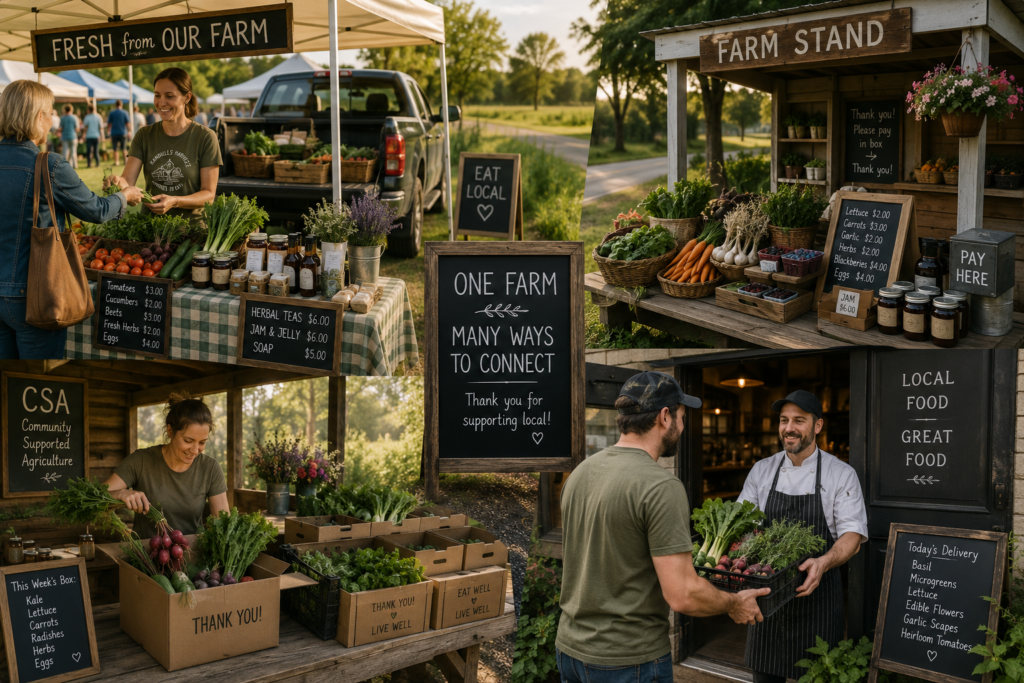
There are some real advantages to it. You get face-to-face interaction with customers. People can sample products, ask questions, and begin recognizing you over time. If you’re selling value-added products like jams, herbal teas, soaps, trellises, baked goods, or handcrafted items, farmers markets can become as much about personality and branding as the products themselves.
People begin buying from you, not just from your tomatoes.
That matters.
Farmers markets are also one of the fastest ways to test products. You can learn very quickly what people are interested in, what price points work, and what products attract attention. Sometimes something you thought would be a side item suddenly becomes your best seller.
But farmers markets also have hidden costs people don’t always think about.
You’re investing:
- time
- fuel
- setup and teardown
- weather exposure
- booth fees
- signage
- packaging
- labor
- long Saturdays
And there’s another reality nobody likes to talk about:
sometimes you spend ten hours preparing for a market only to have poor turnout because of weather, local events, or people staying home.
That can be discouraging.
For extroverted people who enjoy conversation and community, farmers markets can feel energizing. For others, they become exhausting very quickly.
The Farm Stand
Farm stands are almost the opposite.
Instead of hauling products to town, the customer comes to you.
That changes the entire dynamic.
A small roadside stand can start very simply. A table under a canopy. A cooler with eggs. A shelf with jams and produce. Maybe even an honor-system cash box or digital payment sign.
The overhead is usually much lower than a farmers market, and once the setup exists, it can operate with surprisingly little labor.
Farm stands work especially well if:
- your property has decent road visibility
- you live near commuter traffic
- you’re in a rural area where people appreciate local food
- you have repeat seasonal products
- you prefer less direct interaction
And honestly, there’s something deeply old-fashioned and appealing about stopping at a roadside stand. It feels personal in a way grocery stores never do.
But farm stands have limitations too.
Traffic matters enormously. A beautiful stand on a road nobody travels won’t do much. You also lose the built-in customer flow that a busy farmers market provides. At a market, people arrive already intending to buy something. With a roadside stand, you have to attract attention from passing traffic or existing customers.
Signage becomes critical.
Consistency matters too. If customers stop twice and find the stand empty both times, they may stop checking.
Still, for many small homesteads, especially in rural areas, farm stands become one of the simplest and most peaceful forms of local sales.
CSA Programs
CSA stands for Community Supported Agriculture.
In a CSA model, customers essentially subscribe to the farm ahead of time. They pay upfront at the beginning of the season and receive weekly boxes of produce or products throughout the growing season.
This model solves one of the biggest problems small growers face:
cash flow early in the season.
Seeds, soil amendments, irrigation supplies, tools, compost, chicks, feed, greenhouse plastic—all of those costs happen before harvest.
CSA memberships help fund production before products are ready.
There’s also a relationship aspect to CSA systems that many people love. Customers become emotionally invested in the farm itself. They follow the seasons. They learn what’s growing. They often become repeat supporters year after year.
But CSA systems are also demanding.
You are committing to consistency.
That means:
- planting schedules matter more
- crop failures affect commitments
- weekly packing becomes mandatory
- communication becomes important
- variety matters
A CSA can become stressful if production planning is weak.
Customers also need education sometimes. Modern grocery stores have conditioned people to expect every vegetable every week of the year. CSA customers may need to learn that real seasonal agriculture doesn’t work like that.
Still, when done well, CSA systems can create one of the most stable and loyal customer bases a small farm can have.
Selling Directly to Restaurants
This is the sales path many homesteaders overlook entirely.
Restaurants, especially locally focused restaurants, farm-to-table establishments, bakeries, breweries, cafes, and higher-end chefs are often searching for reliable local products.
Not necessarily huge quantities.
Reliable quantities.
That distinction matters.
Chefs care deeply about consistency. If you promise basil every Tuesday, they want basil every Tuesday. If your blackberries are exceptional, they may build desserts around them. If you grow unusual herbs, edible flowers, specialty mushrooms, or heirloom produce, you may find markets that pay extremely well compared to standard retail produce pricing.
Restaurants also value products that tell a story.
“Locally grown in the North Carolina Sandhills” has marketing value to them too.
And unlike farmers markets, restaurant sales can sometimes move larger quantities quickly without requiring hours of face-to-face retail interaction.
But restaurant sales require professionalism.
Communication matters.
Delivery timing matters.
Cleanliness matters.
Reliability matters.
A chef who runs out of ingredients during dinner service will remember it.
This model tends to work especially well for:
- specialty crops
- herbs
- microgreens
- edible flowers
- mushrooms
- berries
- garlic
- high-quality eggs
- unique peppers
- seasonal specialty products
It can also pair beautifully with value-added products. A local bakery may want blackberry syrup. A restaurant may want herb blends. A coffee shop may want locally made honey or dried herbal teas.
The Real Secret: Multiple Streams
Honestly, most successful small homesteads eventually blend several methods together.
Maybe:
- a small CSA provides predictable baseline income
- a farm stand sells overflow produce
- a few restaurant accounts buy specialty items
- occasional farmers markets help build visibility
- value-added products extend the season
- online sales create year-round income
That layered approach creates resilience.
If rain hurts market attendance, restaurant sales still exist.
If tomatoes fail, herbal products may still sell.
If produce season slows down, jams and soaps continue moving.
That’s one of the hidden lessons of homesteading in general:
systems work better than dependence on one thing.
Whether it’s power systems, water systems, or income systems, diversity creates stability.
And honestly, that may be one of the most “off-grid” ideas there is.