One of the biggest mindset shifts in homesteading, off-grid living, or even small-property entrepreneurship is realizing that the real money often isn’t in the raw material itself.
It’s in what you turn it into.
A rough-cut 2×6 board has value, sure. But cut it, sand it, stain it, and turn it into a handcrafted garden trellis, and suddenly you are no longer selling lumber. You’re selling something finished. Something useful. Something attractive. Something that solved a problem for somebody who didn’t have the tools, the time, or the creativity to build it themselves.
That’s value-added thinking.
And honestly, for small homesteads and small producers, it may be one of the most important financial concepts there is.
A person with thousands of acres might make money through sheer volume. But most people trying to build freedom through homesteading or off-grid living are working with smaller pieces of land, limited equipment, and limited capital. That means competing on bulk usually doesn’t work very well.
But small producers can compete in creativity, craftsmanship, personality, and authenticity.
That’s where adding value becomes powerful.
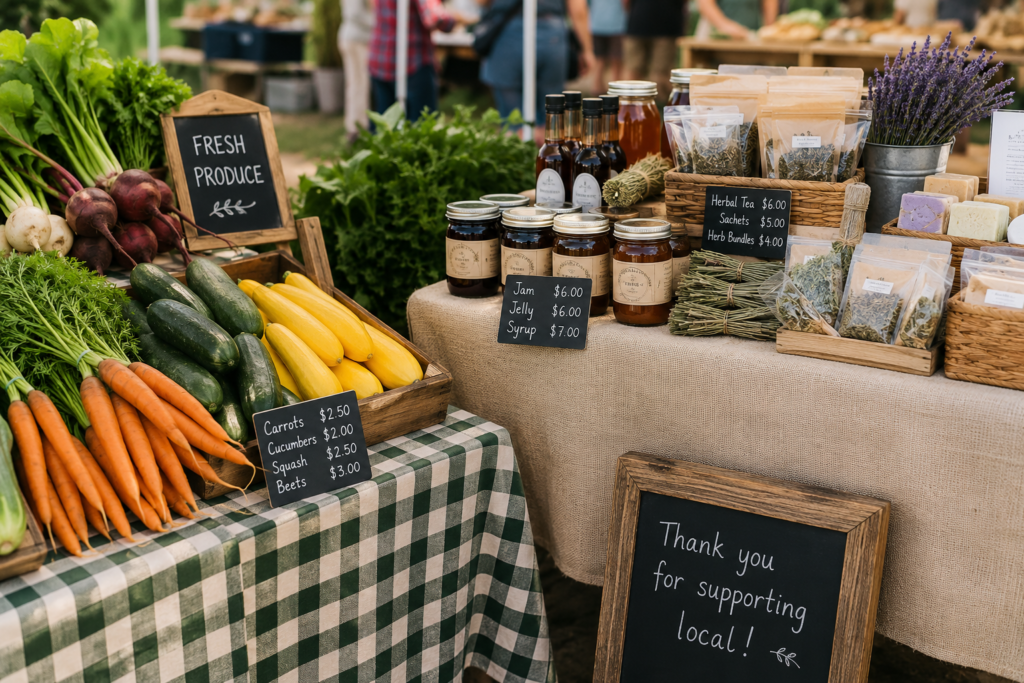
Blackberries are a good example. Fresh berries are great, but there’s usually a pretty low ceiling on what somebody can charge for a basket of berries sitting on a table. Turn those same berries into homemade jam, syrup, jelly, or dessert topping in a mason jar with a simple rustic label, and now the value changes completely.
The customer is no longer just buying fruit.
They’re buying convenience. Flavor. Nostalgia. Homemade quality. Maybe even the memory of something their grandmother used to make.
People buy stories every bit as much as they buy products.
That matters more today than it has in a long time.
The same thing happens with herbs. A handful of herbs might not seem particularly valuable at first glance, but dry them properly and suddenly they become tea blends, seasoning mixes, herbal sachets, bath products, or handcrafted gifts. Lavender can become bundles hanging in a farmhouse kitchen, oils, soaps, or little sewn sachets people put in drawers and closets.
The plant didn’t necessarily change all that much.
But the usefulness multiplied.
That’s the key.
Adding value creates a multiplier effect.
And sometimes the increase comes from surprisingly simple things. Cleaning a product better. Packaging it attractively. Combining several items together into a gift basket. Creating instructions or recipes that go along with it. Even presentation itself has value.
That’s true far beyond food.
A person might sell raw wood cheaply. But handcrafted raised-bed kits, rustic signs, porch planters, or trellises suddenly become premium items because the labor, design, and creativity are already built into them.
Even information works this way.
In many ways, that’s part of what OTG Tiny is becoming.
The internet already has endless articles about solar panels, batteries, gardening, and homesteading. The value isn’t simply in repeating information that already exists. The value comes from real-world experience, practical mistakes, lessons learned, and helping people avoid expensive problems before they happen.
That’s value-added knowledge.
A solar panel is a product.
Explaining how to size it properly, what mistakes to avoid, why conservation matters first, and how systems actually behave in the real world—that’s where additional value gets created.
Sometimes even the waste products become opportunities.
Scrap wood becomes kindling bundles or rustic crafts. Extra herbs become tea mixes. Ugly fruit becomes jam. Chicken manure becomes compost. Pine needles become mulch or basket filler. The byproduct that looked worthless at first glance can sometimes become its own income stream.
That changes the way you start looking at a homestead.
Instead of only asking:
“What can I grow?”
You begin asking:
“How many useful things can come from what I grow?”
That question changes everything.
It also reveals one of the hidden advantages small producers have over large companies.
Small homesteads can pivot quickly.
You can try small batches. Experiment. Test ideas at a farmer’s market. Sell a few handmade items online. Create a seasoning blend, a tea mix, a jar of syrup, or a handcrafted wooden product without needing a massive factory or corporate approval process.
If something works, you make more.
If it doesn’t, you adjust.
That flexibility is a real advantage.
And honestly, this approach applies to more than physical products. It applies to building multiple income streams in general.
One small product may not change your life overnight.
But several small systems working together start creating resilience:
a little affiliate income,
a few handcrafted products,
some digital downloads,
a seasonal garden product,
consulting work,
maybe a course or a book.
Individually they may seem small.
Together they begin acting more like a river than isolated puddles.
That’s one of the real lessons behind homesteading and off-grid living in the first place. A healthy homestead rarely depends on one single system. Not one crop. Not one power source. Not one income stream.
The more systems you develop, the more stable life becomes when one of them has a bad season.
And in many ways, adding value is simply learning how to see possibility where other people only see raw material.