
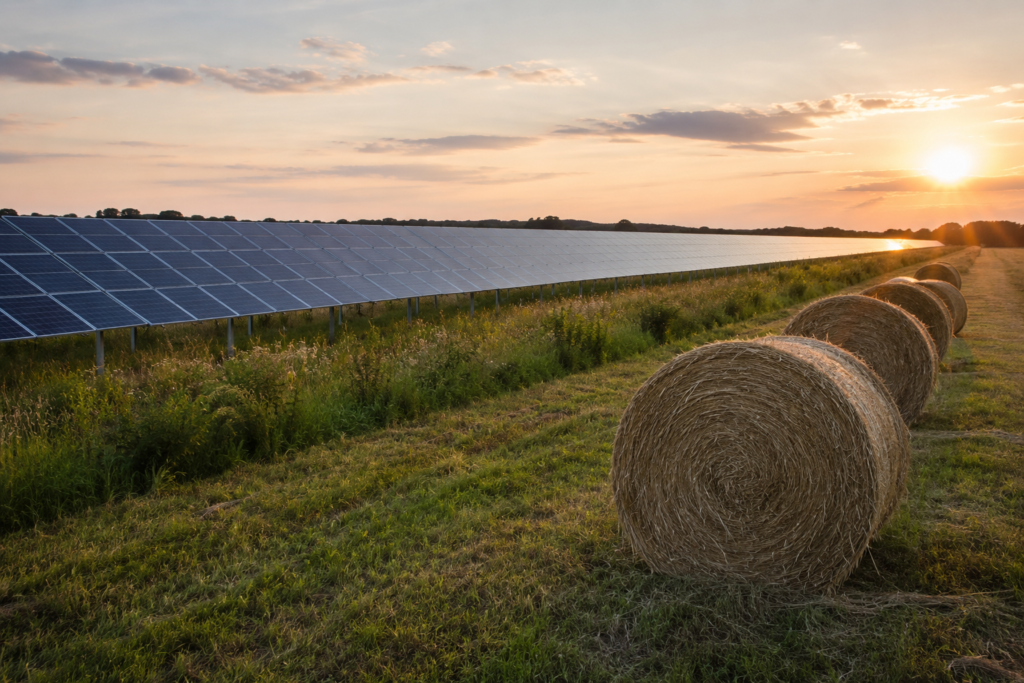
If you are dreaming about going off-grid, solar can look simple from the outside. Panels go on the roof or on the ground, batteries store power, and the lights stay on. But the truth is more practical than that: off-grid solar is not really about panels. It is about seasons, timing, limits, and learning how to work with nature instead of expecting nature to work around you.
That is why the old phrase “make hay while the sun shines” fits off-grid living so well. Most people hear it as a bit of farm wisdom. In reality, it is also a very good solar principle. When the sun is available, you use it. When conditions are good, you make the most of them. Because in off-grid life, power is not endless, and the best time to prepare for darkness is while the sun is still up.
Off-grid solar is not about unlimited energy
Many people begin their off-grid journey with a grid-tied mindset. That is understandable. If you have spent your life connected to the utility, electricity feels almost invisible. You flip a switch and expect power to be there. You turn on a pump, a fridge, a heater, or a washer, and it just works.
Off-grid living changes that relationship. Suddenly, energy becomes something you can measure, manage, and run out of if you are not careful. The sun rises and sets on its own schedule. Clouds happen. Winter happens. Equipment has limits. Batteries fill up. Inverters reach capacity. Loads surge. And every system eventually faces a difficult stretch of weather or demand.
That is why the real question is never, “How does the system perform on the best day?”
The real question is, “What happens on the worst one?”
Why winter matters more than summer
One of the biggest mistakes new off-grid owners make is focusing on annual averages instead of the hardest season. A solar system can look excellent in summer. Long days, strong sun, and full batteries can make everything seem more than adequate. Then winter arrives and the story changes.
The days are shorter.
The sun sits lower in the sky.
Cloud cover lingers longer.
Morning fog delays production.
Snow and ice may interfere.
Heating loads increase.
People spend more time indoors.
Trees that barely mattered in July can cast major shadows in December.
That is why off-grid design is usually driven by winter performance, not summer abundance. A system that works in July but struggles in January is not a reliable off-grid system.
Array tilt is more important than many people realize
If you are new to solar, panel angle may seem like a minor detail. It is not. Tilt affects how well your array captures sunlight across the seasons, and for off-grid systems, winter collection often matters more than maximum annual output.
A flatter tilt may produce strong yearly numbers, especially when summer is doing most of the heavy lifting. But a steeper tilt can improve winter harvest, help shed snow, and better match the lower angle of the sun when energy is hardest to get.
That does not mean there is one perfect angle for every site. It means the goal matters. If you are grid-tied, annual production might be the priority. If you are off-grid, survivability in the lean season is usually more important than chasing the highest annual total.
Batteries are stored time, not magic
Batteries are one of the most misunderstood parts of an off-grid system. They do not create power. They store it. In a very real sense, a battery bank is stored time. It lets you carry yesterday’s sunlight into tonight’s darkness.
That is powerful, but it is still finite.
Once the battery bank is full, extra solar production may be wasted if there is nowhere for it to go. The charge controller throttles back. The inverter limits what can be used. The energy exists, but the system cannot always absorb it.
That is why experienced off-grid owners think differently. They do not just ask how much power they can produce. They ask how intelligently they can use power when it is available.
Run the washing machine while the batteries are floating.
Pump water during strong solar hours.
Charge tools at midday.
Schedule heavy loads when production is high.
Use the surplus when it is there instead of cycling the batteries unnecessarily.
That is what “make hay while the sun shines” looks like in real life.
Batteries still have rules
Good batteries are a major advantage in off-grid living, but they are not a cure-all. They still have limits, and those limits matter.
Depth of discharge matters.
Temperature matters.
Cable sizing matters.
Connection quality matters.
Charging behavior changes in cold weather.
Heat affects longevity.
Even lithium iron phosphate batteries, which are popular for off-grid systems, still need proper charging conditions and thoughtful system design.
In other words, batteries are not a shortcut around physics. They are a way to work with it.
Inverter sizing is about surge, not just running watts
Another common mistake is focusing only on everyday wattage. That is only half the story. Many appliances and tools draw much more power at startup than they do while running.
A well pump might run at 1,200 watts but demand several times that when it starts.
Refrigerators.
Air conditioners.
Pressure pumps.
Compressors.
Power tools.
Mini-splits.
All of these can create short surge demands that matter just as much as the normal running load. That is why off-grid systems must be designed for real-world behavior, not just nameplate numbers.
A system that looks fine on paper can still fail if the inverter cannot handle startup surge.
Shading is a bigger deal than most people expect
People often say, “It’s only a little shade.” In solar, small shading can cause surprisingly large losses. Modules are current-limited devices, so partial shading can reduce output more than most new owners realize.
And shading is often worse in winter. A tree line that seems harmless in summer may become a serious problem once the sun drops lower in the sky.
That is why site evaluation should always include winter conditions, not just summer. Summer can make a location look better than it really is. Winter tells the truth.
Off-grid success is mostly about habits
After years in solar and storage, one thing becomes obvious: off-grid success is less about huge production and more about intelligent adaptation.
It is a technical system, yes, but it is also a lifestyle system.
Conservation matters.
Load timing matters.
Simplicity matters.
Generator integration matters.
Realistic expectations matter.
The cheapest kilowatt-hour is still the one you never had to generate.
That idea changes how people live. Off-grid is not about trying to recreate unlimited utility-grid convenience in a remote setting. It is about learning how to live well within real conditions. That takes awareness, discipline, and a willingness to respect the system instead of fighting it.
Dreaming about off-grid life is the beginning, not the end
For many people, off-grid living starts as a dream. More freedom. More self-reliance. Less dependence. A quieter, simpler life. That dream matters. It is what gets people interested in the first place.
But the dream only becomes real when it is paired with understanding.
That understanding starts when you stop asking how to get unlimited power and start asking how to live wisely with the power you have.
That is the heart of off-grid living.
Not that energy is infinite.
But that energy is precious.
Not that limits are a weakness.
But that limits create discipline.
Not that nature is against you.
But that nature is always honest.
A good off-grid system is not the one that looks impressive on a perfect June afternoon.
It is the one that quietly gets through four cloudy winter days without panic, drama, or emergency generator chaos.
That is real design.
That is real resilience.
And that is what “make hay while the sun shines” really means.