
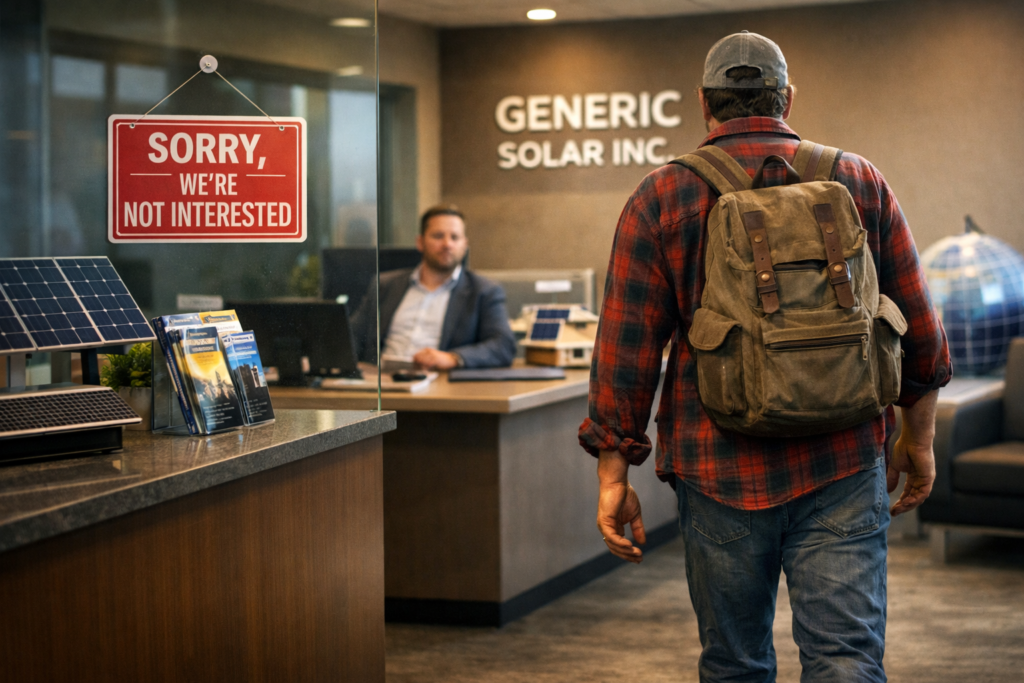
There’s a moment that happens to a lot of people.
You start thinking about going off-grid, or at least running your place on solar, and it seems obvious what the next step is.
You call a solar company.
And you expect them to be excited.
After all… this is what they do, right?
And that’s where most people—and most solar companies—start talking past each other.
Here’s the part nobody really explains.
Most solar companies are not in the business of making you independent.
They’re in the business of installing systems that sit on a house that already works just fine without them.
They want a house that already has power, already has a utility connection, and just wants to shave down a bill a little bit. You put panels on the roof, tie it into the grid, and everybody goes home happy. If something doesn’t produce one day, the grid quietly fills in the gap and nobody even notices.
That’s the lane they live in.
And they’re good at it.
Then you show up.
You’re not asking how to lower your bill.
You’re asking how to replace it.
You’re thinking about cloudy weeks, winter sun angles, batteries, backup power, maybe even cutting the cord entirely. You’re not just looking for equipment—you’re trying to build a system that has to carry you when there is nothing else to fall back on.
That’s a completely different conversation.
Because the minute you go off-grid, the solar company isn’t just installing panels anymore.
Whether they like it or not, they’re stepping into the role of your power company.
And most of them don’t want that job.
Not because they don’t care, and not because they’re trying to sell you something you don’t need. It’s because the moment your system struggles, you don’t call the sun… you call them.
And here’s the part a lot of people don’t want to hear:
The cavalry isn’t coming.
Not at 2 a.m. when the batteries are low.
Not during a week of clouds.
Not when something throws a fault and you don’t recognize the code.
Even if you hire someone to install your system—and that can absolutely be the right move—you still need to understand how it works. At least enough to know what “normal” looks like, and what isn’t.
It wouldn’t hurt to take a look at some of the North American Board of Certified Energy Practitioners material. You don’t have to become the installer, but knowing how these systems are supposed to behave puts you in a completely different position when something goes sideways.
And just as important…
Make sure whoever you buy your equipment from has real tech support. Not a form you fill out and hope someone emails you back next week. I’m talking about a number you can call during the day and actually get a human being who understands the system.
Because when things stop working, that matters a whole lot more than a slick sales pitch.
There’s also something else going on under the surface.
Grid-tied solar is predictable. It’s repeatable. It’s something a company can train a crew to install over and over again with very few surprises.
Off-grid isn’t like that.
It’s personal.
It depends on how you live, what you’re willing to change, what you expect to run, and when you expect to run it. Two houses that look identical from the road can need completely different systems depending on the people inside them.
That’s hard to package. It’s hard to standardize. And it’s even harder to support after the install.
So what happens?
Sometimes they steer you back toward grid-tied.
Sometimes the quote comes in way higher than you expected.
And sometimes the conversation just kind of… fades out.
Not because you’re doing something wrong.
But because you’re asking for something they’re not really set up to deliver.
And here’s the part that actually helps once you see it clearly.
Off-grid isn’t something you buy.
It’s something you participate in.
It asks something of you.
It asks you to understand your own energy use. To notice when you’re using power, not just how much. To think about what really matters and what can wait. To make small adjustments that add up to a system that actually works instead of one that just looks good on paper.
That’s why the first real question was never “How much solar do I need?”
It was always something closer to:
What am I actually trying to do here?
Once you answer that, everything else starts to fall into place.
And you stop being the customer most solar companies don’t want…
…and start becoming the kind of person who can actually make off-grid work.