
Solar is great, but weather and winter still exist.
When people imagine living off-grid, they often picture a small cabin with solar panels on the roof quietly producing all the electricity they will ever need.
Sunlight comes in.
Electricity comes out.
Everything runs silently.
And in many ways, that vision is real. Solar power has become remarkably reliable, and thousands of homes now operate successfully using solar panels and battery storage.
But there’s one thing even the best solar systems cannot control.
The weather.
Clouds, Winter, and Reality
Solar systems produce the most power during long sunny summer days.
Unfortunately, the time of year when people often need the most electricity is winter, when the days are short and the sun sits low in the sky.
Add a few cloudy days in a row, and even a well-designed battery bank can start to run low.
Anyone who has spent time around off-grid systems eventually encounters this moment:
The batteries are dropping.
The forecast isn’t promising.
And it’s time to give the system a little help.
That’s where a generator comes in.
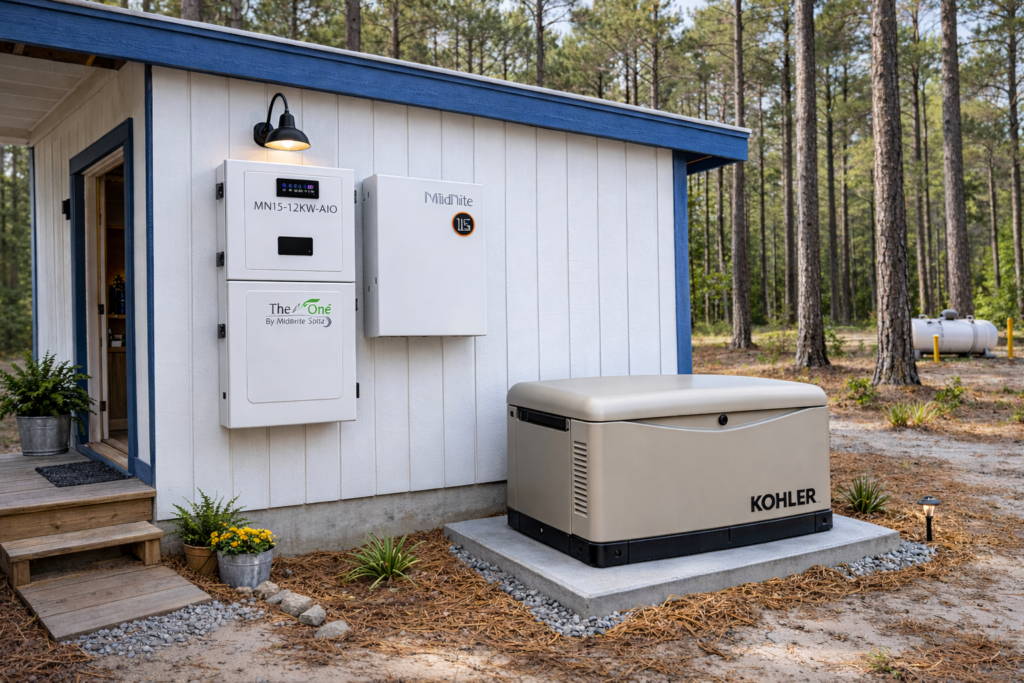
A Generator Is Part of the System
Some people see generators as a failure of an off-grid solar system.
In reality, they’re simply another tool that keeps the system reliable.
Solar panels handle daily energy production.
Batteries store that energy for nighttime use.
The generator fills in the gaps when the weather refuses to cooperate.
Sometimes that means charging batteries after several cloudy days. Other times it means supporting a heavy electrical load — things like a well pump, power tools, or equipment in a workshop.
In a well-designed off-grid system, the generator might only run occasionally.
But when it’s needed, it becomes incredibly valuable.
Why Oversizing Solar Isn’t Always the Answer
Some people assume the solution is simply installing more solar panels and more batteries.
And sometimes that works.
But designing a system large enough to handle the absolute worst weather conditions of the year can become very expensive very quickly.
You may only experience those conditions a few times each winter.
Using a generator occasionally during those rare periods is often far more practical than building a massive solar system designed for the worst possible week of the year.
Off-grid living is often about finding the balance between independence, reliability, and cost.
A generator helps maintain that balance.
Common Generator Fuel Options
Off-grid homes use a variety of generators depending on location, fuel availability, and personal preference.
Gasoline generators are common because they are inexpensive and widely available. They are often used for portable backup power.
Propane generators are popular for homesteads because propane stores well for long periods and burns relatively clean.
Diesel generators are often found in larger systems or remote locations where durability and fuel efficiency are priorities.
Each fuel type has advantages, but the goal is always the same:
Reliable power when solar production temporarily falls short.
Reliability Matters More Than Ideals
There is a certain romance surrounding off-grid living.
People imagine cutting every connection to conventional infrastructure and relying entirely on renewable energy.
But successful off-grid systems are built around something even more important than ideals.
Reliability.
Solar panels provide the daily energy.
Batteries store it.
And generators stand ready for the moments when nature reminds us that sunlight isn’t guaranteed.
Generators aren’t a failure of an off-grid system.
They’re simply part of making the system dependable.
Systems Work Together
Here on OTG Tiny, off-grid living always comes back to three foundations:
Power systems, water systems, and waste systems all work together to support an independent life.
A generator may not be the most glamorous piece of equipment on the homestead, but it’s often one of the most useful.
Sometimes the quiet hum of a generator for a few hours is the difference between a system that struggles and a system that works.
And when your systems work reliably, the rest of off-grid life becomes a lot simpler.