
I’ve seen people spend real money on good equipment and then stick the panels wherever they could make them fit. On the roof because it was there. Off to the side because it was close. Behind a tree line because it felt tucked away and out of sight. It all made sense at the time. And then the system never quite performed the way it should have.
Not because the equipment was wrong.
Because the sun didn’t agree with the decision.
Solar isn’t just hardware. It’s exposure. It’s timing. It’s angles you don’t think about until the middle of winter when the sun is lower and shorter and suddenly that “small amount of shade” turns into a real problem.
That’s the part that catches people off guard. In the summer, everything looks fine. The days are long, the sun is high, and even a less-than-ideal setup feels like it’s working. Then winter shows up, and now the margin is gone. The trees you ignored are now blocking more than you expected. The roof angle that seemed good enough isn’t quite right. And the system that should have carried you is now just keeping up—barely.
At that point, it’s not a solar problem. It’s a placement problem that’s already been built in.
A lot of decisions get made around convenience. Shorter wire runs. Easier install. Keeping everything close to the house. And I get it—those things matter when you’re building.
But they don’t produce power.
If you’re off-grid, or even thinking about it, you’re not just putting panels somewhere. You’re deciding where your power is going to come from every day for years. That deserves more thought than “this spot is easy.”
The better way to think about it is to stop asking where solar can go and start asking where the sun already wants it. There’s always a best spot on a property. It might not be near the house. It might not be where you’d prefer. But it’s the place that gets the most consistent, uninterrupted light across the year, not just on a nice day in July.
That’s the spot that matters.
And if you build around that instead of trying to force the system into a convenient location, everything else gets easier. Not at the beginning, maybe. But over time, which is where most of these decisions actually show up.
This is one of those things that doesn’t hurt right away. It just quietly limits you until the day you realize you’re working harder than you should be for the power you already paid for.
Most solar ends up on the roof.
Not because it’s the best place for it, but because it’s the most obvious place to put it.
The roof is already there. It’s out of the way. It feels efficient. And if you’re working with a typical installer on a grid-tied system, that’s usually where the conversation ends. Panels go up, power comes down, and everyone moves on.
But that whole line of thinking starts to fall apart a little when you’re talking about tiny houses.
Because now the roof isn’t just a convenient surface. It’s a limited one.
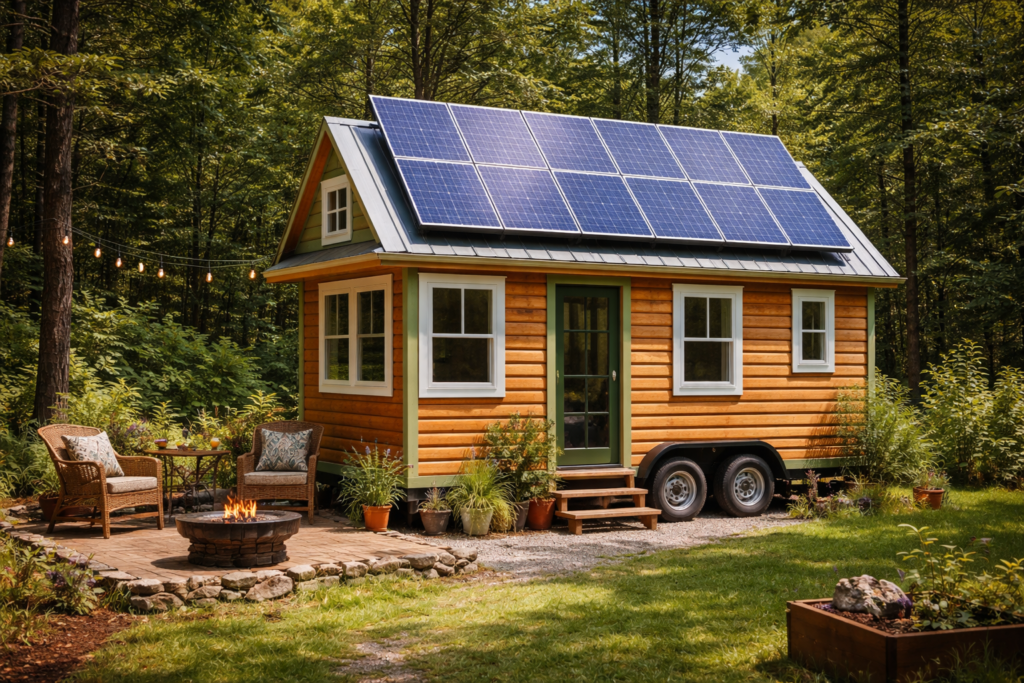
You don’t have much space to begin with. A 12×20 structure doesn’t give you a lot of real estate, and what you do have is often broken up by vents, pitch, orientation, or just the simple fact that the roof isn’t facing the direction you actually want. So right out of the gate, you’re trying to make your entire power system fit onto something that was never really designed for it.
And sometimes it’s not just limited—it’s not even an option.
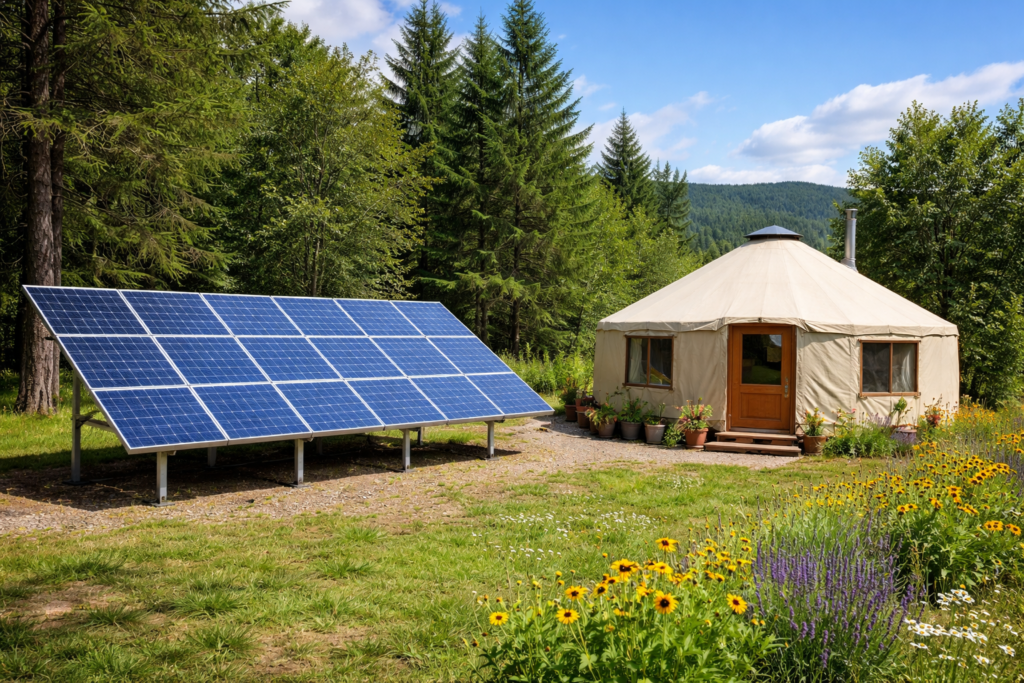
A lot of small structures aren’t built to carry the extra load. A yurt is a perfect example. It’s strong in the way it’s meant to be strong, but it’s not designed to have rigid panels mounted up top. Even some cabins and sheds, depending on how they’re framed, start to get questionable once you add weight, wind load, and snow into the equation.
So before you even get into performance or maintenance, there’s a more basic question:
Does this structure even want solar on it?
A lot of times, the honest answer is no.
But people still try to make it work, because the roof feels like the “right” place.
Even when it does work, you’re still living with it.
A roof mount is easy on day one. It uses space you weren’t doing anything with anyway, and it keeps everything compact. It’s up out of the way. From a distance, it looks clean and finished, like it belongs there.
But if you’re relying on that system—really relying on it—your relationship with it changes.
Now it’s not just something that sits there. It’s something you need to access, maintain, understand. And a roof is not a great place for any of that.
It’s hot when you don’t want it to be. It’s slick when you don’t need it to be. And it turns simple things into bigger tasks than they should be. Cleaning panels, checking connections, dealing with snow—none of that is impossible, but none of it is convenient either.
I remember what it’s like dealing with panels in the winter, and not from the ground. Up there, where every step matters just a little more. It’s not dramatic. It’s just unnecessary.
Then there’s the performance side that people don’t talk about as much. Heat builds up on a roof. Panels don’t like heat. So the place that feels like a natural mounting surface ends up quietly costing you output over time. Not enough to be obvious in a single day, but enough to matter across seasons.
A ground mount feels like more work at the beginning. It costs more. It takes planning. It might even feel like you’re overbuilding.
But with small structures, it’s often not overbuilding—it’s just building correctly.
You’re no longer trying to squeeze your system onto a surface that’s too small or not designed for it. You’re putting it where it actually works. You can size it properly. You can orient it properly. You can expand it later without redesigning everything.
And then you live with it.
You can walk up to your system. You can clean it without thinking about it. You can adjust it. You can fix something without it turning into a project. You’re not adapting yourself to the system. The system adapts to you.
That difference doesn’t show up on install day. It shows up later, when you realize one setup is something you interact with easily and the other is something you avoid unless you have to.
Most people optimize for the install because that’s the part right in front of them.
But when you’re working with a tiny house, or a yurt, or anything small and simple, the better question isn’t “Where can I put panels?”
It’s: “What kind of system does this structure actually support?”
And sometimes the honest answer is:
“It shouldn’t be on the roof at all.”