
You can have the cleanest solar setup in the county.
Panels dialed in. Batteries humming. Inverter doing its thing like it’s supposed to.
You can even have water figured out—pumped, filtered, stored like a pro.
But sooner or later, reality shows up.
You ate.
You drank.
Now what?
This is the part nobody puts in the thumbnail. Nobody leads with it. And yet, if you get this wrong, it will make the rest of your off-grid life miserable in a hurry.
Power is optional for short periods. Water… less so.
Waste? That’s daily. Non-negotiable.
Most People Start With No Plan
Let’s just be honest about how this usually goes.
People get excited about solar. They’ll spend weeks figuring out panel wattage, battery capacity, inverter sizes. They’ll run PVWatts until they can practically recite it in their sleep.
Water comes next. Maybe a well, maybe hauling, maybe rain catchment.
And waste?
That gets pushed off into the mental category of “I’ll figure that out later.”
Later shows up fast.
So the first “system” ends up being whatever can be bought quickly:
A bucket.
A camp toilet.
Something with a bag in it.
And for a little while… it works.
Until it doesn’t.
Smell starts to matter.
Flies start to matter.
Convenience really starts to matter.
And if you’re not living alone, this is usually where the real conversations begin.
The “Just Deal With It” Phase
There’s a version of off-grid living where you just manage it manually.
Carry it out. Dump it somewhere appropriate. Keep things moving.
If you’re on hunting land, weekend property, or something temporary, you can get away with this longer than you think.
But if you’re trying to actually live this way? Day in and day out?
This is where people burn out.
It’s not the work—it’s the repetition. The fact that it never stops. The fact that it’s always waiting for you.
Off-grid doesn’t remove responsibility. It concentrates it.
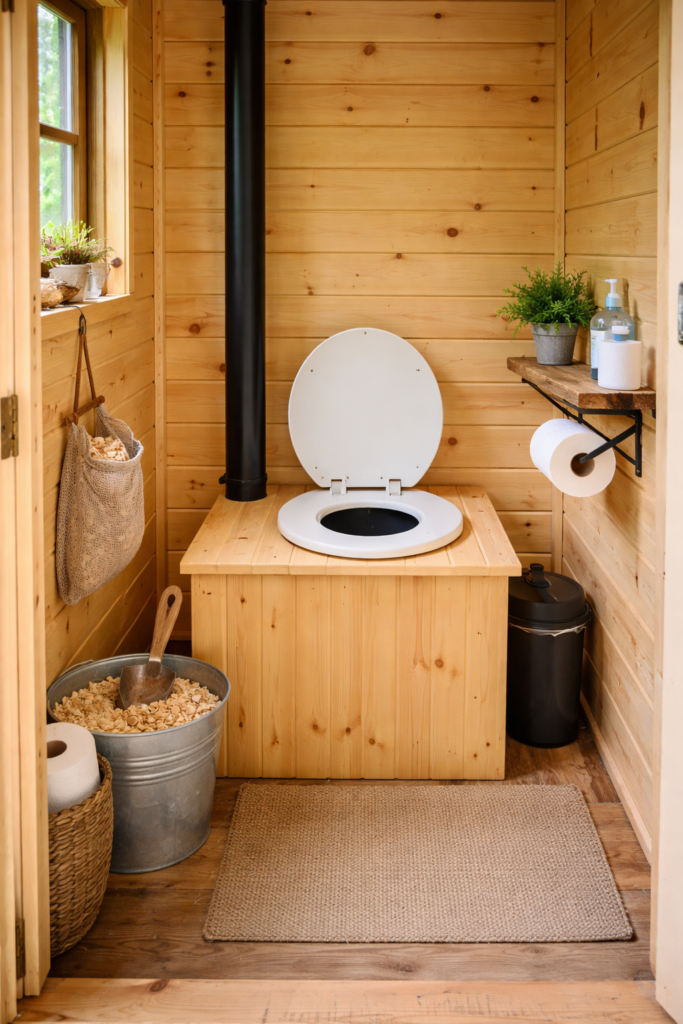
Composting Toilets: Not a Product, a System
This is where a lot of people land next.
They hear “composting toilet” and think they’ve found the off-grid cheat code.
And to be fair—these can work really well.
But here’s the truth most listings won’t tell you:
You didn’t buy a toilet.
You signed up for a system.
Now you’re managing:
Moisture.
Carbon material—sawdust, peat, something to balance things out.
Ventilation.
Temperature.
And eventually… emptying.
That last part is where a lot of the romance fades.
If you set it up right, it’s clean, it’s manageable, and it’s not a big deal. If you don’t, it becomes something you avoid… which makes it worse.
Placement matters too. Inside the main living space? Separate bathhouse? That decision alone changes your experience more than the brand name ever will.
Gravity Still Works (Even Off-Grid)
At some point, a lot of people start thinking a little bigger.
Not necessarily full suburban septic—but something that uses the one thing that never needs a battery:
Gravity.
Depending on where you are and what’s allowed, this might look like:
A traditional septic system.
A simplified drain setup.
Separating gray water from black water.
And this is where off-grid living runs headfirst into reality again—not technical reality, but regulatory reality.
You can leave the grid.
You can’t always leave the county health department.
So now you’re balancing what works… with what’s allowed… with what you’re willing to deal with long term.
What You’re Really Choosing
This is the part most people miss.
Off-grid living isn’t about escaping systems.
It’s about choosing which systems you’re willing to manage.
You’re trading:
A flush handle and a monthly bill…
for
Ownership of the entire process.
That can be incredibly freeing.
Or incredibly frustrating.
Usually both, depending on the day.
Tie It All Together
Power, water, and waste.
Most people get excited about the first two. The third one quietly determines whether the whole thing is sustainable.
Miss your solar sizing, and you’re inconvenienced.
Miss your water system, and you’re uncomfortable.
Miss your waste plan… and you’re done.
Where to Go From Here
If you’re still in the planning phase, don’t skip this.
Think through it now—before you’re standing there with a bucket wondering how you got here.
If you haven’t already, make sure you’ve worked through:
- how much power you actually need
- how you’re going to source and manage water
Because all three of these systems are tied together whether you plan for it or not.
And if you’re already living it?
Then you already know.
This is one of those things you don’t get right once.
You refine it until it works for your life.