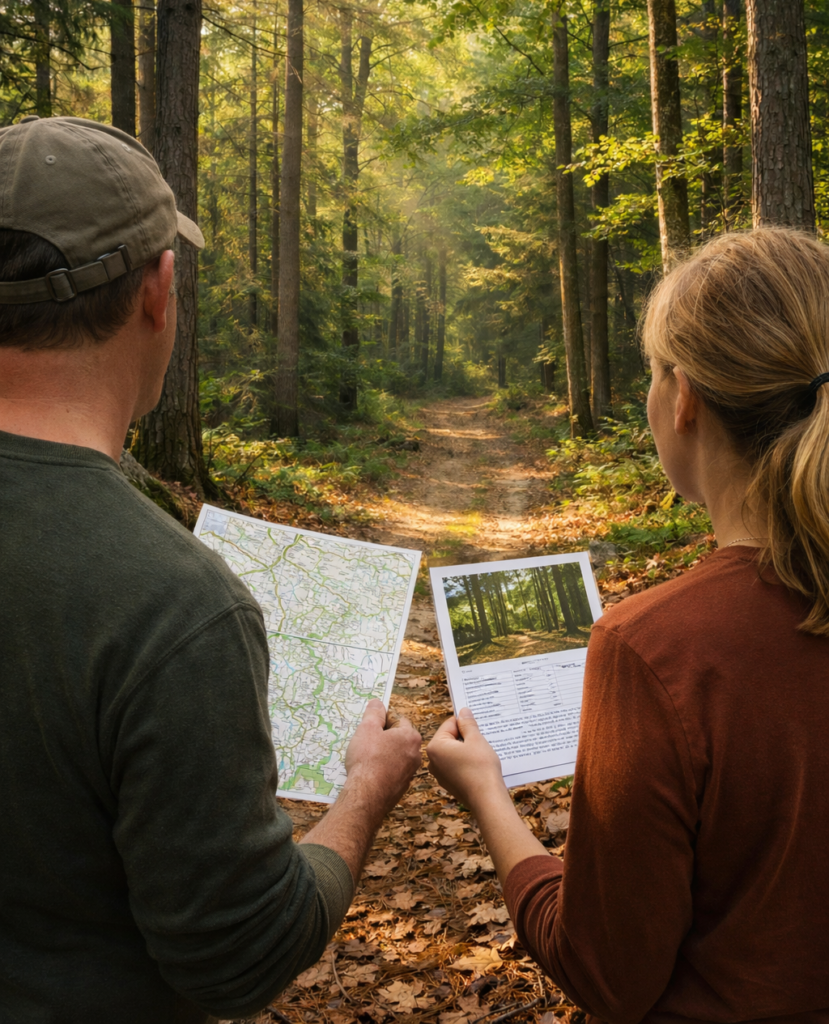
LAND
When people start dreaming about living off-grid, the first thing they usually imagine is the view.
Maybe it’s mountains.
Maybe it’s a quiet meadow.
Maybe it’s a piece of forest where a small cabin sits under tall trees.
The problem is the view is often the least important thing about the land.
A property can look perfect and still make off-grid living extremely difficult, expensive, or even impossible. What actually matters is much less romantic but far more important: water, soil, access, and local regulations.
Those four things will determine whether your off-grid plans become a peaceful life or a constant struggle.
Water Comes First
If there is one lesson people learn quickly when living off-grid, it’s this:
Power is optional. Water is not.
You can live without electricity. People did it for thousands of years. But you cannot live without water.
Before getting excited about a property, start asking practical questions.
How deep are wells in the area?
Do neighboring properties have good water?
Is there a spring, creek, or pond nearby?
Does the region have a history of drought?
Sometimes the best information comes from the people already living there. If nearby homes have wells, ask how deep they are and how reliable they’ve been. In some areas wells reach water at a hundred feet. In others they may need to go three hundred feet or more.
That difference can mean thousands of dollars.
Natural water sources like springs or creeks can make land much more practical for off-grid living, but even those should be evaluated carefully. Some creeks are seasonal and disappear during dry months.
Reliable water is the foundation everything else depends on.
Soil Matters More Than People Think
Many people buying land imagine gardens, orchards, and maybe a few animals. Whether any of that works depends heavily on the soil.
Some land has rich loam that grows almost anything. Other land is mostly sand, clay, or rock and takes years of improvement before it produces much of anything.
Soil also affects septic systems. In many places you cannot legally build a home unless the property passes a percolation test, often called a perc test. This determines whether wastewater can drain properly through the soil.
If the soil fails that test, building options can become limited or expensive.
Good soil makes life easier. Poor soil can be improved, but it’s helpful to know what you’re starting with.
Access Is Often Overlooked
Another common mistake people make when buying rural land is overlooking access.
A property might be beautiful and inexpensive, but if reaching it requires crossing someone else’s land without a legal easement, that can become a serious problem.
You want to confirm the land has legal access, either through road frontage or a recorded easement.
Beyond the legal side, there is the practical side.
Can building materials be delivered there?
Can emergency vehicles reach the property?
What happens when the road turns muddy after heavy rain?
Living off-grid already requires self-reliance. Starting with land that is difficult to reach can make everything harder than it needs to be.
Zoning and Local Regulations
Many people assume rural land means they can build whatever they want.
Sometimes that’s true. Sometimes it isn’t.
Even rural counties often have zoning rules, building codes, septic regulations, and minimum dwelling sizes. Some places are relaxed about small cabins, alternative homes, and off-grid systems. Others are far more restrictive.
This is where talking with the local Authority Having Jurisdiction (AHJ) becomes important. In most areas that means the county planning office, zoning office, or building department.
A simple conversation can answer a lot of questions:
Are small cabins allowed?
Are tiny homes permitted?
Is off-grid living allowed without connecting to utilities?
What permits are required before building?
It’s far better to learn these things before buying land than after.
Ask the People Who Already Live There
One of the best sources of information about rural land is often the simplest one: the neighbors.
People who already live in the area know things that never show up on a listing or county website.
They know how deep the wells are.
They know whether the road washes out during storms.
They know where water pools after heavy rain.
If you see someone outside while visiting the property, introduce yourself and explain you’re considering buying land nearby. Most rural communities are surprisingly willing to share what they know.
That local knowledge can save you from expensive surprises.
Use Maps Before You Ever Visit
Modern mapping tools make it possible to learn a lot about a property before ever setting foot on it.
Satellite imagery from Google Maps or Google Earth can show nearby development, forest cover, and surrounding terrain. You can see how close the neighbors are and whether the area is changing over time.
Topographic maps add another layer of understanding. These maps show elevation changes and natural slopes. A property that looks flat in photos may actually sit in a drainage area or shallow valley.
Topo maps can reveal where water naturally flows across the land.
Understanding those patterns can help you decide where a home, driveway, garden, or solar array might work best.
Check the Weather History
Climate plays a much bigger role in off-grid living than many people realize.
Before buying land, spend some time looking at the local weather history.
Average winter temperatures, summer heat, rainfall totals, and drought patterns all affect daily life.
Solar production depends heavily on local sunlight conditions. Gardening depends on growing seasons and rainfall. Heating systems depend on winter temperatures.
Understanding the long-term weather patterns helps set realistic expectations for how the property will behave.
Flood Maps Matter
Flooding is another factor worth checking early.
The FEMA flood maps available online show whether land sits inside a designated floodplain. Properties located in flood zones can face building restrictions, septic limitations, or higher insurance requirements.
Even if land sits outside the official floodplain, it’s still wise to observe how the surrounding terrain handles water. Talking with neighbors and studying topographic maps can reveal whether an area tends to collect runoff during heavy storms.
Water almost always tells the truth about land.
LiDAR: Seeing the Land Under the Trees
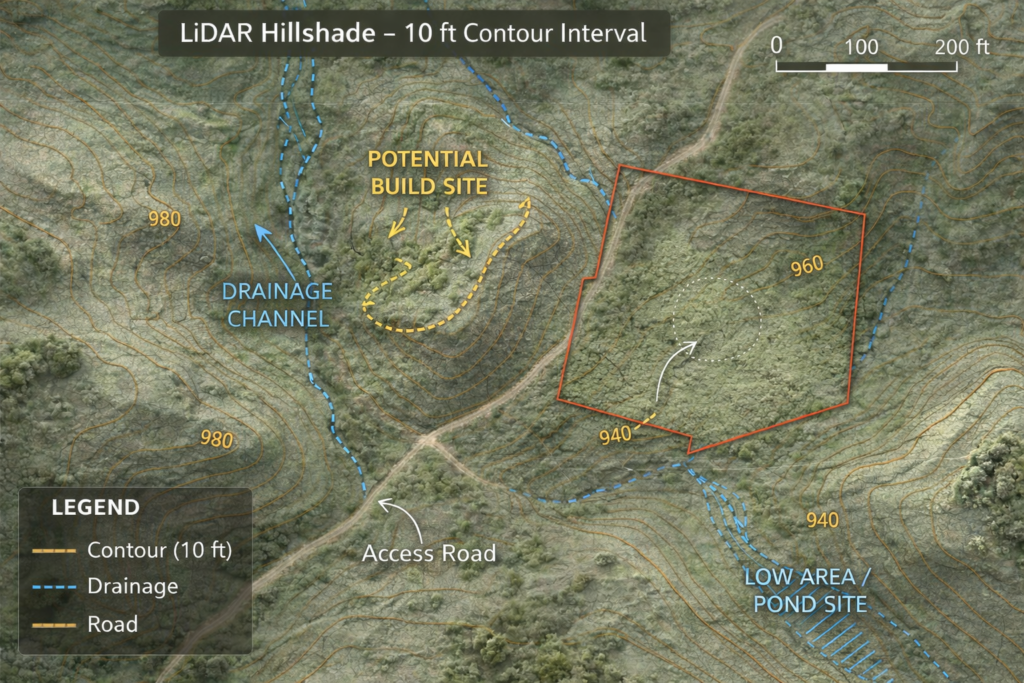
One of the most powerful tools available today for evaluating land is LiDAR mapping.
LiDAR stands for Light Detection and Ranging, but the simple explanation is that it allows you to see the shape of the ground even when the land is covered in trees.
Instead of just seeing the forest canopy in aerial photos, LiDAR removes the trees and reveals the actual terrain underneath.
This can expose things that are difficult to see otherwise:
natural drainage paths
hidden creeks or seasonal streams
old logging roads or farm roads
terraces or previous building sites
high ground and low areas where water collects
Many states now make LiDAR data available through public GIS mapping systems. In North Carolina, for example, LiDAR data is accessible through NC OneMap.
For someone planning an off-grid homestead, LiDAR can reveal the bones of the land before you ever walk it.
Photos show what the land looks like.
LiDAR helps reveal what the land does.
Walk the Land
Maps and data are helpful, but nothing replaces walking the property itself.
Spend time moving across the land slowly. Look for signs of water movement, wet areas, rock outcrops, and natural high spots.
Pay attention to how the sun moves across the property and where open spaces exist. Imagine where a small home might sit and where gardens or solar panels might receive the best sunlight.
The land usually tells its story if you take the time to observe it.
The Right Land Makes Everything Easier
Choosing land for off-grid living is not about finding the most beautiful property.
It’s about finding land that works with your plans instead of fighting them.
Reliable water.
Reasonable soil.
Legal access.
Realistic local regulations.
When those pieces are in place, everything else becomes easier: building shelter, installing solar power, growing food, and creating a life that is more independent.
The view will still matter.
It just shouldn’t be the first thing you choose.