
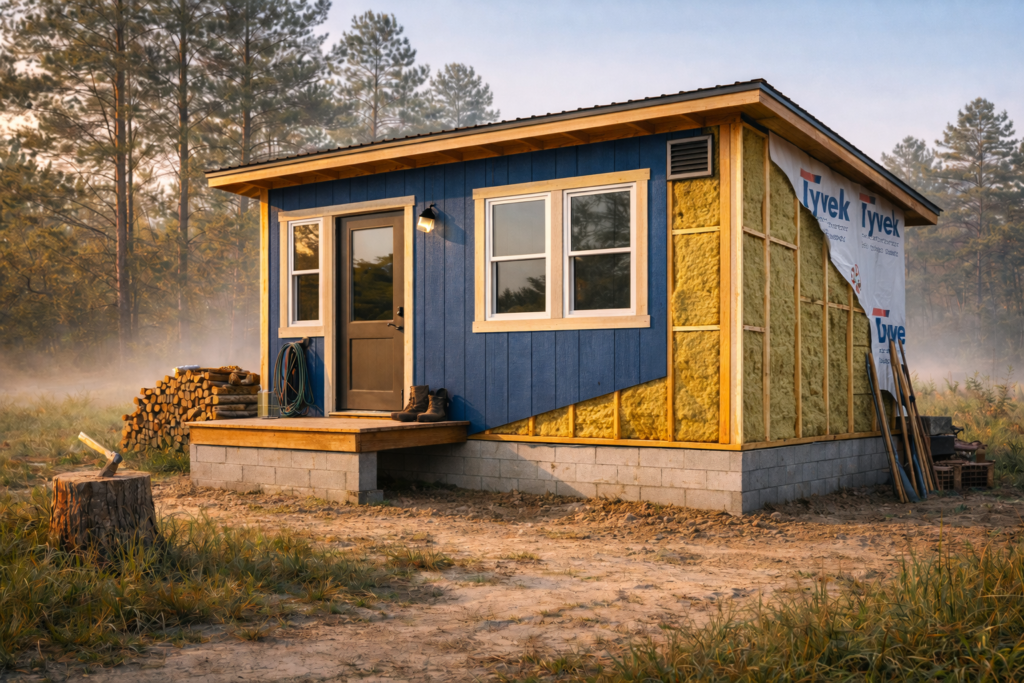
When you’re building a tiny house—especially off-grid—it’s easy to get focused on the visible parts. The walls go up, the roof goes on, and it starts to feel like a home.
But comfort doesn’t come from how it looks.
It comes from how it behaves.
And that comes down to three things that don’t get enough respect: the foundation, the insulation, and the ventilation. If those three are working together, the place feels solid, dry, and livable. If they’re not, you’ll fight that house every single day.
The Foundation: What’s Happening Under You Still Counts
Even if your tiny house is sitting up on blocks, piers, or a trailer, you still have a “foundation.” It’s just not poured concrete.
And what’s happening under your house matters more than most people think.
Cold air doesn’t just stay outside. It moves. It pulls heat right out of your floor. In the winter, that can make a small space feel uncomfortable fast. You end up chasing it with more heat, but the problem isn’t your heater—it’s what’s happening underneath you.
Then there’s moisture.
Ground moisture doesn’t ask permission. It rises, it lingers, and if you give it a place to sit—under a poorly managed crawl space or an open underside—it will find its way into your structure.
That’s where you start getting that damp feeling, the kind you can’t quite explain but you definitely don’t like.
Skirting helps. Insulating the underside helps. Managing airflow under the house is a big deal.
You don’t need to overcomplicate it, but you do need to acknowledge that the ground is part of your system whether you like it or not.
Insulation: It’s Not Just Thickness, It’s Control
Insulation gets talked about a lot, but usually in the wrong way.
People focus on numbers. R-values. Thickness. What product is “best.”
What matters more is how well the whole system is put together.
Insulation is there to slow things down—heat leaving in the winter, heat coming in during the summer. But it only works if it’s installed well and paired with proper air sealing.
If air is moving freely through your walls, your insulation isn’t doing what you think it is.
In a tiny house, you feel this faster than in a big one. There’s no buffer. A small air leak, a missed seam, a poorly sealed penetration—it all shows up right away.
Cold spots. Hot spots. Drafts where there shouldn’t be any.
I’ve lived through this. Materials that looked great on paper but didn’t perform because the system wasn’t tight.
The goal isn’t just to insulate. It’s to create a space where you’re in control of what comes in and what stays out.
Ventilation: Fresh Air Without Letting the House Fall Apart
Now here’s where people either ignore things completely or go too far the other way.
You tighten up a tiny house—which you should—and now you’ve got a different problem.
Where does the moisture go?
Every time you cook, breathe, shower, or even just exist in that space, you’re adding moisture to the air. In a small structure, it doesn’t take much before it starts building up.
If it has nowhere to go, it finds a place to settle.
Windows. Corners. Inside walls if things get bad enough.
That’s when you start seeing condensation, and if it goes on long enough, mold isn’t far behind.
Ventilation isn’t about making the house drafty again. It’s about controlled air movement.
A simple exhaust fan. Cracking a window at the right time. Being intentional about moving air through the space instead of letting it stagnate.
You’re not trying to let the outside take over—you’re just giving the inside somewhere to breathe.
When These Three Work Together
This is where things start to feel right.
The floor isn’t cold for no reason.
The air doesn’t feel damp or stale.
The temperature holds instead of constantly drifting.
You’re not fighting the space—you’re living in it.
And here’s the part that matters for the kind of life we’re talking about:
When your shelter works, everything else gets easier.
You need less energy.
You deal with fewer problems.
You spend more time living and less time fixing.
That’s the goal.
Not perfection. Not overbuilding.
Just a place that works with you instead of against you.