There’s a trap a lot of people fall into when they start thinking about homesteading, off-grid living, or sustainable living. They focus on one giant thing.
Usually it’s solar.
Or chickens.
Or gardens.
Or the tiny house.
Or the dream piece of land.
But a homestead is never just one thing. A working homestead is a collection of systems that support each other.
You need a water system.
You need a food system.
You need a waste system.
You need an energy system.
You need a heating and cooling strategy.
You need storage.
You need maintenance plans.
You need backups for your backups.
And the same principle applies financially.
One of the biggest mistakes I see people make is trying to build a self-reliant life while still depending on a single source of income.
That’s not resilience. That’s a different version of dependence.
The Homestead Mindset Is About Stability, Not Fantasy
A lot of folks romanticize homesteading. They picture rows of vegetables, goats in the pasture, a wood stove glowing in the winter, and jars of canned tomatoes lined up on shelves.
There’s nothing wrong with that picture.
But what keeps the dream alive is not the aesthetic. It’s systems.
The people who succeed long-term usually aren’t the people with the prettiest setup. They’re the people who understand redundancy, adaptability, and cash flow.
Because the truth is simple:
Your tomatoes don’t care that your truck transmission failed.
Your solar array doesn’t care that your hours got cut at work.
Your chickens don’t stop eating because the economy gets rough.
Life keeps happening.
A resilient homestead isn’t built on one paycheck any more than it’s built on one rain barrel.
“Owe No Man Anything…”
There’s a verse in Romans that says:
“Owe no man anything, except to love one another.”
That doesn’t mean never borrowing money under any circumstance. It means living in a way where you are not constantly trapped under systems you cannot control.
Homesteading, at its core, is about reducing fragility.
Not eliminating work.
Not escaping responsibility.
Not pretending the modern world doesn’t exist.
It’s about creating layers of stability.
That means your homestead should eventually have multiple ways to feed you, multiple ways to power you, multiple ways to water you, and yes—multiple ways to fund you.
A Job Is Fine. Dependence Is Dangerous.
There is nothing wrong with having a job. Most people transitioning into homesteading should keep one for a while. Some people should keep one permanently.
But depending entirely on one employer is risky.
Companies close.
Managers change.
Injuries happen.
Markets shift.
Entire industries collapse.
The same people who understand why an off-grid home still needs a generator sometimes forget that their financial life also needs backup systems.
A generator is redundancy.
Residual income is redundancy.
A side business is redundancy.
Teaching skills is redundancy.
Selling produce is redundancy.
A small online store is redundancy.
The goal isn’t necessarily to become rich.
The goal is to become harder to destabilize.
Your Homestead Can Produce More Than Food
One of the mindset shifts people need to make is understanding that a homestead is not just a place that consumes resources.
It can also produce value.
Sometimes that value is obvious:
- Eggs
- Honey
- Vegetables
- Meat birds
- Fruit
- Firewood
- Herbs
- Plants
But there are other things a homestead can produce too.
Knowledge.
Experience.
Education.
Entertainment.
Community.
Encouragement.
In today’s world, those things matter.
There are people making income from teaching bread making, herbal medicine, composting, beekeeping, off-grid systems, gardening, food preservation, blacksmithing, woodworking, and animal care.
Some of them are making more from teaching the skill than from the actual product itself.
That doesn’t mean becoming fake or turning your life into a performance. It simply means recognizing that experience has value.
If you spent ten years learning how not to kill blueberry bushes in sandy soil, that knowledge is worth something to somebody else.
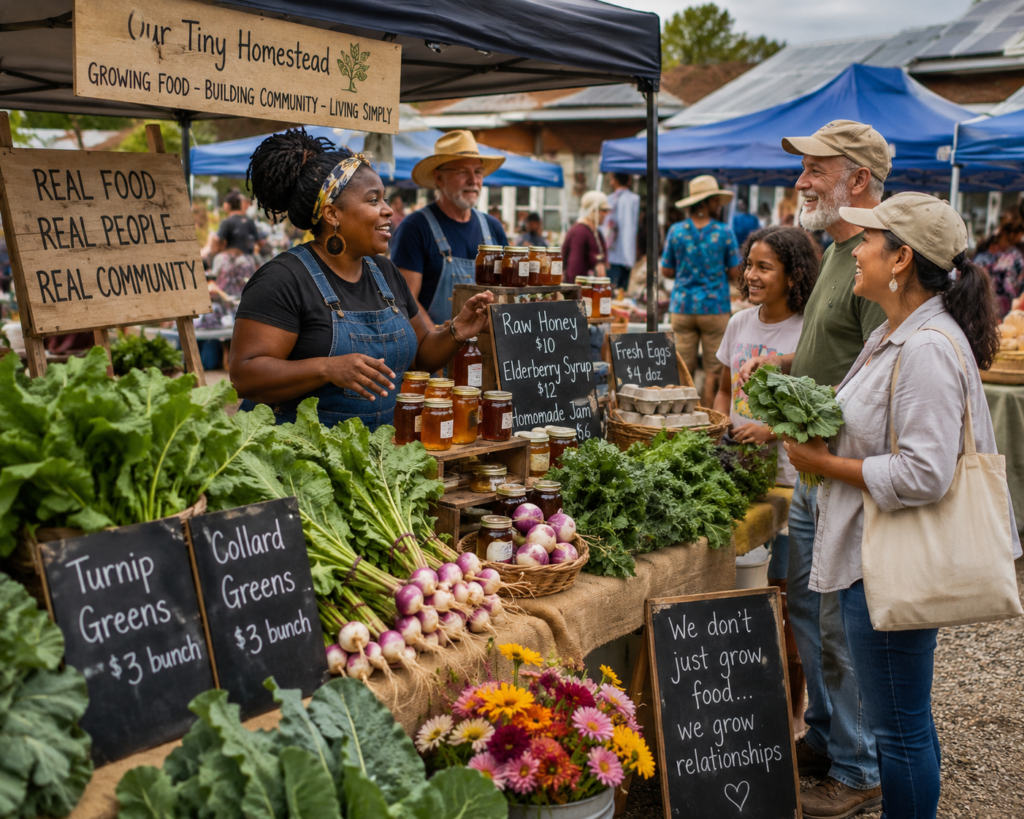
Farmers Markets Are About More Than Vegetables
A farmers market is not just a place to dump extra zucchini.
It’s networking.
It’s visibility.
It’s community building.
It’s learning what people actually want.
A lot of homesteaders discover that the thing they thought would sell isn’t what people care about at all.
Maybe your tomatoes do fine.
But your homemade salsa sells out in thirty minutes.
Maybe your lettuce struggles.
But your blackberry jam becomes your signature product.
Maybe your produce booth barely breaks even, but someone hires you afterward to help build raised beds or teach a workshop.
You start realizing something important:
The homestead economy is often relational before it is transactional.
People buy from people they trust.
Agritourism and Ecotourism Are Growing
People are hungry for experiences now.
Especially experiences that feel real.
There are families who have never gathered eggs.
Never seen a goat milked.
Never picked blueberries.
Never sat around a fire under actual darkness without city glow.
That creates opportunity.
Agritourism doesn’t have to mean building a giant commercial destination. Sometimes it’s simple:
- Farm tours
- Workshops
- Weekend classes
- Birdwatching trails
- “Learn to Garden” days
- Harvest festivals
- Tiny cabin stays
- Primitive camping
- Homestead dinners
- Herbal walks
- Photography weekends
If you own land, especially beautiful land, there is potential there beyond traditional farming.
And if you already enjoy teaching or talking to people, that may become one of the most valuable systems on your property.
The Internet Changed the Homestead Economy
Twenty years ago, if you wanted to make money homesteading, your customer base was mostly local.
That isn’t true anymore.
A small homestead can now produce digital products, education, videos, articles, plans, consultations, affiliate recommendations, printable guides, eBooks, or courses.
That doesn’t mean every homesteader needs to become an influencer.
Honestly, most people probably shouldn’t.
But sharing useful information online can absolutely become one of the support systems that stabilizes a homestead financially.
A simple blog post about how you solved a problem may help thousands of people.
And if that article points to a product you genuinely use and trust, affiliate income can become another small stream feeding the larger river.
One stream may not support you.
Five or six streams together might.
Residual Income Is the Solar Battery of Financial Systems
Think about what a battery system actually does.
It stores excess production from one time period so it can support you later when conditions are poor.
Residual income works similarly.
A book you wrote two years ago might still sell.
An article might still generate affiliate income.
A downloadable guide might still bring in a few dollars every month.
A campground spot might still stay booked seasonally.
A blueberry patch planted today may produce for years.
A fruit tree is delayed income.
So is content.
So is education.
So is reputation.
The point is not instant gratification.
The point is building systems that continue working after the initial labor is done.
That’s one of the biggest mindset shifts in homesteading.
You stop thinking only in terms of hourly labor and start thinking in terms of systems that continue producing.
Some Systems Will Fail
This part matters.
Not every idea works.
You may raise a crop nobody buys.
You may spend money on equipment you barely use.
You may try selling something and discover there’s no local market.
That’s normal.
A failed system is not a failed life.
Good homesteaders adapt constantly.
The same way you adjust gardens for drought, pests, or soil conditions, you adjust income systems too.
Maybe the goat milk soap business never takes off.
But the workshops do.
Maybe produce sales are mediocre.
But people love your seedlings.
Maybe your YouTube channel goes nowhere.
But your local seminars fill up.
Pay attention to what naturally gains traction.
Community Is Still One of the Most Valuable Systems
This matters more than people realize.
You can have solar.
You can have tools.
You can have water storage.
You can have gardens.
But eventually everybody needs help.
Community is one of the most overlooked homestead systems there is.
Knowing people who weld, garden, plumb, butcher, can food, repair engines, troubleshoot solar, preserve meat, or simply show up when life gets hard matters enormously.
And community doesn’t appear magically.
You build it intentionally.
Sometimes that means joining local groups.
Sometimes it means helping neighbors.
Sometimes it means teaching.
Sometimes it means simply introducing yourself and bringing over a jar of homemade pickles.
People remember generosity.
Start With What’s In Your Hand
One of the biggest mistakes people make is waiting for the perfect setup before they begin.
You do not need 100 acres.
You do not need a tractor.
You do not need a giant barn.
You do not need to quit your job tomorrow.
Start with what is already in your hand.
Maybe you know gardening.
Maybe you know electrical systems.
Maybe you know baking.
Maybe you know woodworking.
Maybe you know birds, herbs, rabbits, seeds, mushrooms, cooking, sewing, photography, or fixing small engines.
The modern homestead economy rewards practical skills.
Especially real ones.
Build Systems Slowly and Intentionally
A strong homestead is usually built in layers.
Not overnight.
One fruit tree.
One rain barrel.
One raised bed.
One workshop.
One article.
One side business.
One connection.
One extra stream of income at a time.
Over the years, those systems begin supporting each other.
And eventually something powerful happens:
You stop feeling like one bad month could wipe everything out.
That’s freedom.
Not luxury.
Not perfection.
Freedom.
Key Questions to Ask Yourself
- What systems already exist on my property or in my life?
- Which systems are missing entirely?
- Am I financially dependent on only one source of income?
- What skills do I already possess that could help others?
- What products, services, or experiences could my homestead realistically provide?
- What is one additional income stream I could begin building this year?
- Who around me could become part of my community system?
- What systems could continue producing value even when I am not actively working?
- What failed ideas have actually taught me something useful?
- Am I building a lifestyle that is resilient—or just aesthetic?