
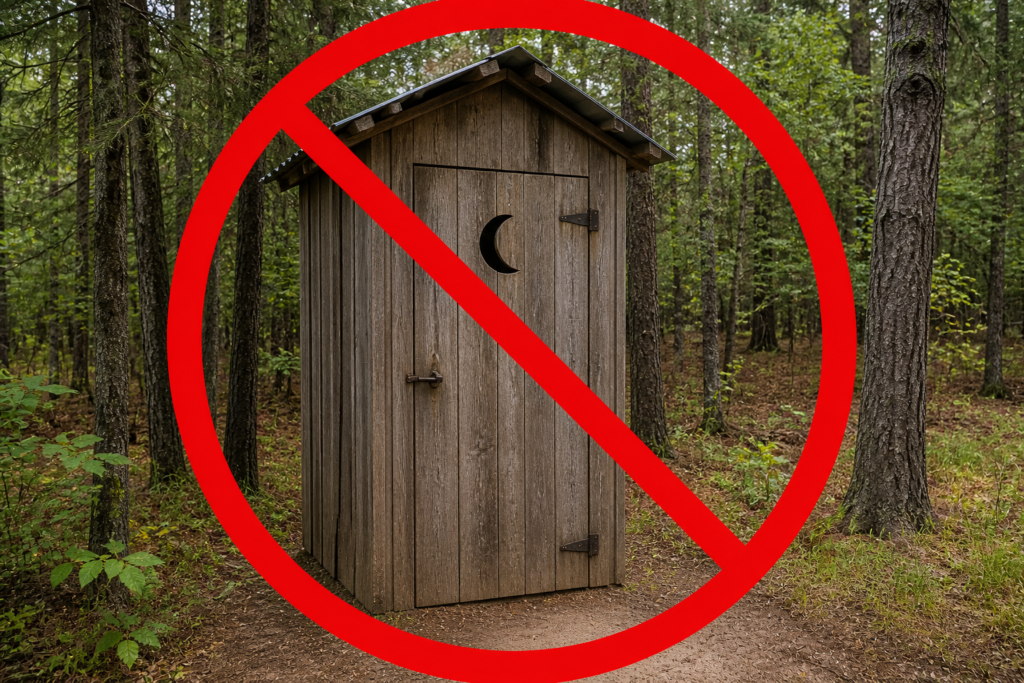
There’s a part of off-grid living nobody really puts in the photos.
It’s not the solar.
It’s not the cabin.
It’s not even the land.
It’s this quiet question that shows up pretty quick:
“Alright… what am I doing about waste?”
You can kick a lot of decisions down the road when you move onto property.
This isn’t one of them.
If you don’t deal with this early—and deal with it right—you’re going to feel it. Every day.
Let me just say this up front.
Yeah… people dig holes.
Outhouses exist. Always have.
But I’m not going to point you in that direction if you’re planning to actually stay on your land.
Around here—Sandhills, sandy soil—water moves. What goes in the ground doesn’t just politely stay there. It travels.
So now you’re not just “handling waste”…
you’re gambling with your water.
And once that’s a problem, it’s not a small problem anymore.
If you’re serious about building something out here, there are better ways to do this.
After you’ve been at this a while, you start to see the same three paths show up over and over.
You either separate it.
You let it compost.
Or you try to turn it into something useful.
That’s really it.
I keep it simple.
I use a urine-diverting setup from Joolca.
Liquids go one way. Solids go another.
That one change gets rid of most of the problems people fight—smell, mess, things getting out of hand.
For one person, it’s hard to beat. You stay ahead of it instead of dealing with it after the fact.
And what happens after matters too.
On the solid side, things stay relatively dry. That’s a big deal. You can help it along—tissue, a little wood chips, even something like a wipe—and now you’re dealing with something manageable instead of something you dread.
For me, it all stays contained and it goes out with the trash.
Some systems want you separating everything into different containers—waste here, paper there, everything else somewhere else.
I understand why they do it.
But in real life, that means you’re carrying things out of the one place they belong and moving them somewhere else, hoping nothing goes sideways on the way.
I’d rather not.
Keeping it simple and contained has worked better for me.
There’s another piece to this that nobody really tells you until you run into it.
How you handle waste doesn’t just affect your system…
it affects how social your place is.
I learned that the hard way back in New York.
At the time, I was running a pretty basic bucket setup. It worked. No question about that.
But people noticed.
Nobody came out and said anything. That’s not how it goes.
Visits just got shorter.
Then less frequent.
Then eventually… they stopped.
Not because of me.
Because of the setup.
That was a wake-up call.
When someone comes out to your place, especially if they’re not living this lifestyle, they’re already a little outside their comfort zone.
Sanitation is one of those lines people feel immediately.
A cleaner, more thought-out system doesn’t just make your life easier.
It makes it easier for other people to be there.
Once you’ve got more than one person using the system every day, things change a little.
That’s where composting toilets start to make more sense.
You’re not dealing with everything immediately—you’re letting the system carry some of that load over time.
I’ve worked with setups like Air Head and Clivus Multrum, and they do what they’re supposed to do if you set them up right.
They’re not hands-off. Nothing off-grid is.
But they give you a little breathing room. You’re not thinking about it every single day
Then there’s the one people get curious about.
Methane digesting systems.
Instead of separating or composting, you’re feeding everything into a digester and letting it break down without oxygen.
You get gas out of it. In theory, you can cook with it.
And I get the appeal.
It sounds like the perfect loop—waste goes in, fuel comes out.
But this is where I slow people down a little.
These systems want consistency.
They like steady input.
They like stable temperatures.
They need someone paying attention.
If you’ve got multiple people on-site all the time and you’re willing to run it like a system, it can be interesting.
If you’re keeping things small and simple, it’s usually more than you need.
There’s also nothing wrong with a traditional septic system, even off-grid.
It’s not flashy, but it works.
In a lot of places, it’s the easiest way to stay on the right side of local rules without a long conversation.
Just don’t make the mistake of burying it and forgetting it.
Leave access.
Because at some point, it’s going to need to be pumped.
That’s not a maybe. That’s a when.
And this is where the unfun part comes in—but it matters.
Before you build anything, talk to your local AHJ—your Authority Having Jurisdiction.
Counties, towns, inspectors… whatever it is where you are.
Some places are fine with composting systems.
Some will allow urine-diverting setups.
Some won’t recognize anything except septic.
And it’s not always obvious until you ask.
It’s a whole lot easier to make a phone call up front than to tear something out later because it doesn’t meet code.
Off-grid doesn’t mean off the radar.
So what should you actually do?
Don’t overthink it.
Match the system to how you’re living right now.
If it’s just you and you want simple—separate it.
If there’s more use—compost it.
If you want to build something bigger and stay on top of it—look at methane.
Just don’t pick something because it sounds cool.
Pick something you’ll actually maintain.
You can put off a lot of decisions when you go off-grid
This one doesn’t wait.
Get it right early, and everything else feels easier.
Get it wrong… and you’ll be reminded of it every single day.