If you strip away the romance, the Instagram photos, and the YouTube thumbnails, off-grid living comes down to three very practical problems you have to solve.
Power.
Water.
Waste.
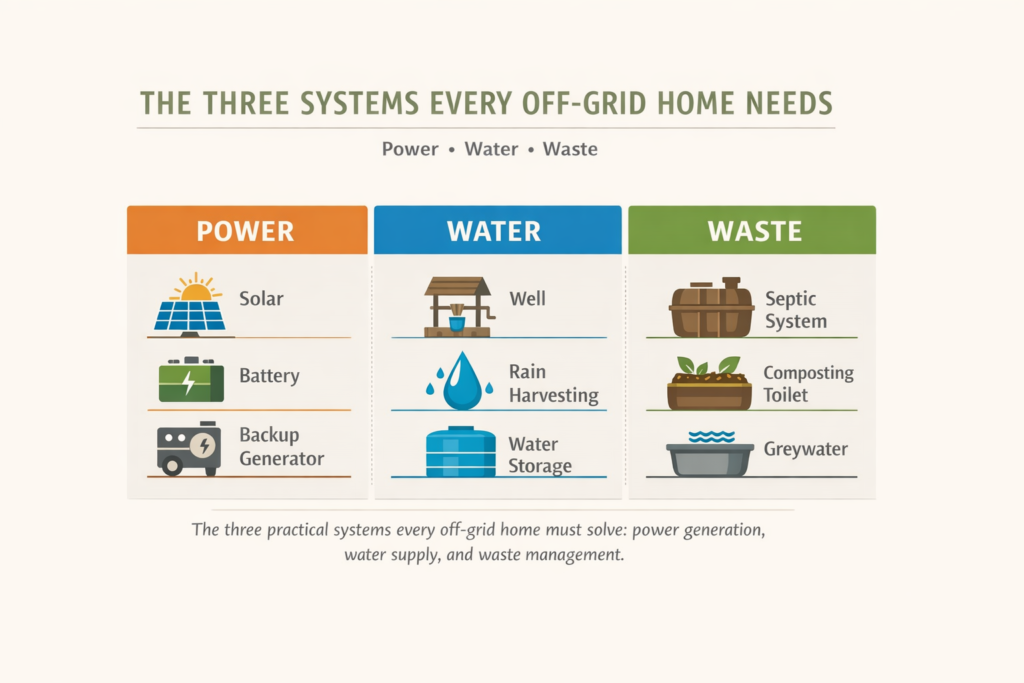
Everything else is optional.
You can debate tiny houses versus cabins, gardens versus livestock, or whether you need one acre or fifty. But if you can’t solve those three systems, you’re not living off-grid — you’re camping.
When I lived off-grid in a yurt for twelve years, those three systems determined whether life was comfortable or miserable. When they worked, life felt peaceful and simple. When one of them failed, everything else stopped.
Let’s walk through them.
Power: The System Most People Think About First
Modern life runs on electricity whether we like it or not.
Lights, refrigeration, water pumps, tools, internet, and sometimes heat all depend on it. That means your off-grid home needs a reliable way to generate and store power.
For most people today that means solar panels, batteries, and a backup generator.
The solar panels collect energy during the day.
The batteries store it so you can use it at night.
The generator fills in the gaps when the weather doesn’t cooperate.
But before you install any of that, there’s something far more important.
Conservation.
The cheapest kilowatt-hour you will ever have is the one you never needed in the first place.
Efficient appliances, LED lighting, and learning to live within the limits of your system matter far more than buying more panels. I’ve seen people spend tens of thousands of dollars trying to build a solar system big enough to support wasteful habits.
It’s far easier to reduce the load than it is to produce more power.
When I lived off-grid, that meant things like drying clothes on a line, paying attention to how long lights were left on, and understanding that cloudy weeks meant adjusting how power was used.
If you design your life to need less energy, your off-grid system becomes dramatically simpler and cheaper.
Water: The System That Actually Determines Where You Can Live
You can live without electricity for a while.
You cannot live long without water.
Every off-grid property needs a reliable water source. That might be a well, a spring, rain catchment, or some combination of those things. Each option comes with advantages and challenges depending on where you live.
When I lived in New York, my primary water source was a spring coming out of the hillside. It was dependable, clean, and required very little pumping. But it also meant protecting the intake from freezing and making sure debris didn’t clog the line.
In other places a drilled well is the most practical option. In dry climates, rain catchment and large storage tanks can become essential.
But even if you plan to stay on the grid, water still matters.
A friend of mine here in North Carolina was building what was supposed to be his dream home. By the time the framing was up and the house was taking shape, he had already spent hundreds of thousands of dollars on the project.
There was just one problem.
They couldn’t find water.
The first drilled well came up dry. The second attempt didn’t hit anything usable either. At that point he was staring at the very real possibility of having a beautiful new house sitting on land that didn’t have a dependable water source.
Luckily, the third attempt finally struck water.
It wasn’t the high-production well he was hoping for, but it produced enough gallons per hour to make the house livable.
He joked that the timing worked out well because his kids were already grown and out of the house.
Teenagers use massive amounts of water.
Showers, laundry, dishes, more showers — if you’ve raised teenagers, you know exactly what I mean.
The lesson from that story is simple. Water isn’t just an off-grid issue. It’s a land issue.
Before you fall in love with a property, make sure the water situation actually works.
Waste: The System Nobody Wants to Talk About
This is the system people avoid discussing, but it’s just as important as the others.
And if you remember the classic children’s book Everybody Poops, you already understand the basic principle.
It’s simply part of being human.
When you live in town, you flush the toilet and forget about it. A pipe carries everything away to a treatment plant somewhere out of sight.
Off-grid living removes that illusion.
Human waste and household wastewater have to go somewhere, and in most places the law has something to say about how that works.
Some people install conventional septic systems just like you would find in rural homes on the grid. Others use composting toilets combined with greywater systems.
Both approaches can work, but the key is that the system must be legal where you live and appropriate for your climate and soil.
Soil type matters. Drainage matters. Local regulations matter.
It might not be the glamorous part of homesteading, but it’s one of the systems that determines whether your off-grid life works long-term.
And ignoring it is a mistake people sometimes make when they’re focused on the exciting parts of the lifestyle.
Systems First, Dreams Second
A lot of people begin their off-grid journey by imagining the house they want to build.
A cabin in the woods.
A tiny house on a trailer.
A yurt overlooking a meadow.
Those dreams are part of the fun.
But in reality, the smarter place to start is with the systems.
Where will your water come from?
How will you produce electricity?
How will you deal with waste?
Once those questions are answered, everything else becomes easier.
The house, the garden, the workshop — they all grow naturally out of those foundations.
That’s why here on OTG Tiny everything comes back to three things:
If those three pieces work together, the rest of off-grid life becomes a lot simpler.
A Final Thought
When people imagine off-grid living, they often focus on freedom.
And that freedom is real.
But the path to that freedom runs through a few very practical systems that have to be designed well and maintained over time.
If you can solve power, water, and waste, you’ve solved the hard part.
Everything else is just building the life you want around those foundations.