
SYSTEMS
When people start planning an off-grid solar system, they usually begin with panels.
“How many panels do I need?”
That sounds like the right question, but most of the time it isn’t the first one that needs answering.
The least expensive kilowatt-hour you will ever produce is the one you never needed in the first place. Conservation comes before production. Before you start sizing solar, batteries, and inverters, you need to understand your loads, your habits, and what you are actually willing to live with.
During the years I lived completely off-grid in a yurt, every now and then the power would go down and I’d have to track down what went wrong. Most of the time it wasn’t because solar didn’t work. It was because something in the system wasn’t balanced, or because I had not fully accounted for how all the pieces had to work together.
That is where a lot of off-grid systems fail before they even start.
Most failures come from one of a few places. Sometimes the loads are simply too high. A lot of people try to drag a normal American on-grid lifestyle into an off-grid system and then wonder why it struggles. Other times the battery storage is too small, so every cloudy day becomes a problem. And sometimes the issue is not the size of one piece of equipment but the way the entire system was matched together.
An off-grid system is really a loop, not a straight line.
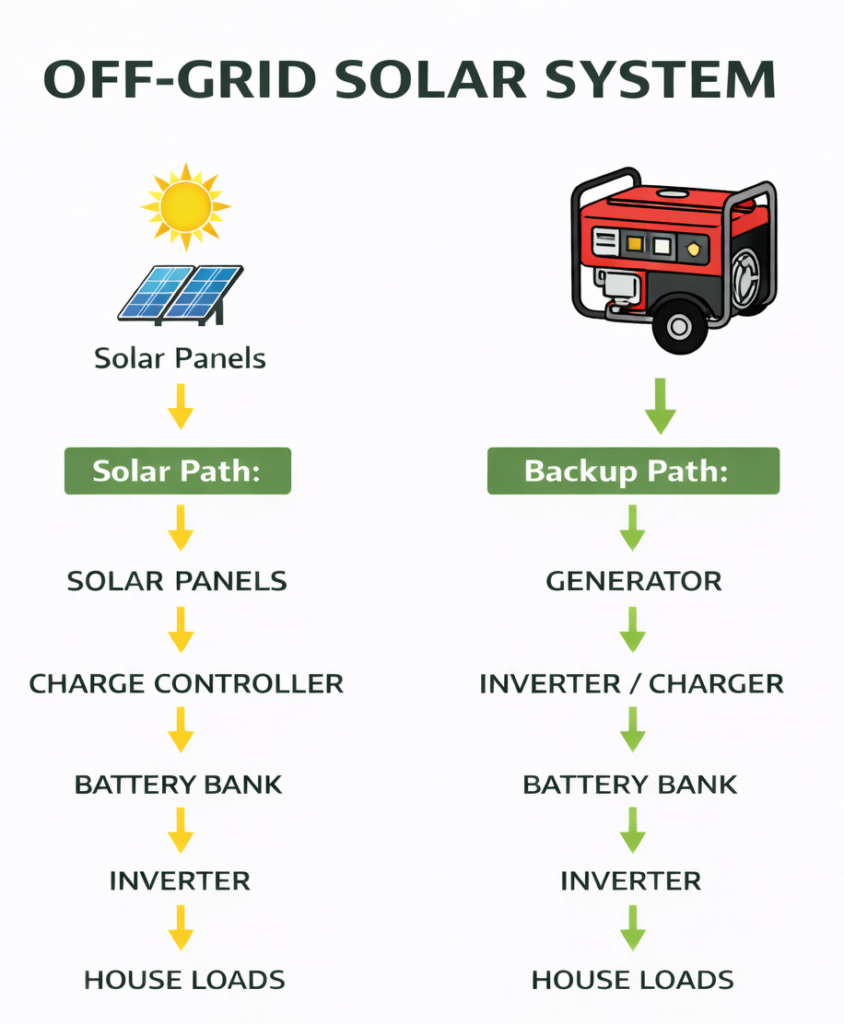
Sunlight hits the panels. The panels feed the charging equipment. The batteries store energy for later. The inverter turns that stored energy into usable AC power for the house. If any one of those parts is badly sized or poorly matched, the whole thing becomes harder to live with.
The goal is not to build the biggest system you can afford. The goal is to build a balanced system that quietly does its job every day.
When the Whole System Lives in One Box
Traditional off-grid systems are usually made up of several separate pieces of equipment. You have solar panels feeding a charge controller. The charge controller fills the batteries. The batteries feed an inverter. The inverter then powers the lights, outlets, and appliances in the living space.
That works, but it also means more wiring, more settings, more places for installation mistakes, and more places to troubleshoot when something goes wrong.
Today I use a MidNite Solar all-in-one system, and that changes the layout quite a bit. Instead of several separate boxes doing separate jobs, the major control elements are combined into one unit. The solar still comes in from the array. The batteries still store energy. The loads still need AC power. But much of the logic and power conversion now lives in one central piece of equipment.
That makes installation cleaner and troubleshooting more straightforward, but it does not mean the rules go away.
You still have to make sure the solar array matches what the hybrid inverter can actually take. That means paying attention to both voltage and amperage, and it means paying attention on both the low end and the high end. If the array voltage is too low, the MPPT may not wake up and track properly, especially early in the morning or under poor conditions. If the voltage is too high, you can exceed the maximum input rating of the inverter and create a much bigger problem. Current matters too. Just because the system is in one box does not mean it will magically accept whatever you throw at it.
The battery voltage also has to match the inverter. If the inverter is designed for a certain battery voltage, then that is what it needs to see. Mismatching battery voltage and inverter design is one of the fastest ways to turn a promising installation into a headache.
Then there are the loads, and this is where a lot of people get surprised.
The loads in the house cannot exceed what the inverter is capable of supplying. It is not enough to say, “My appliances only add up to this many watts,” and call it good. Off-grid systems have to deal with startup surges, and that is where LRA becomes a big issue.
LRA means Locked Rotor Amps. It shows up with motor loads like well pumps, refrigerators, freezers, air conditioners, and anything else with a compressor or motor that has to start under load. A device may run at a fairly modest power level once it is going, but the starting surge can be several times higher for a brief moment.
That matters a lot off-grid.
On the utility grid, those brief surges are usually absorbed without much thought because the grid can supply a huge amount of current for a moment. Off-grid, your inverter has to survive that surge by itself. If the inverter cannot handle the startup demand, the system may trip, fault, or simply refuse to start the load.
That is why an off-grid system is never just about solar panels. It is not just about batteries either. It is about matching the solar input window, the battery voltage, the inverter’s real capabilities, and the actual loads the house is going to demand, including startup surge.
When those pieces are balanced, off-grid power can feel simple and dependable. When they are not, even good equipment can look bad.
The system still has to follow the same basic truth it always did: capture enough energy during the day, store enough for the night and poor weather, and deliver power to the loads without asking the inverter to be something it is not.
That is true whether the system is made up of separate boxes or whether much of it now lives inside one modern all-in-one unit.